
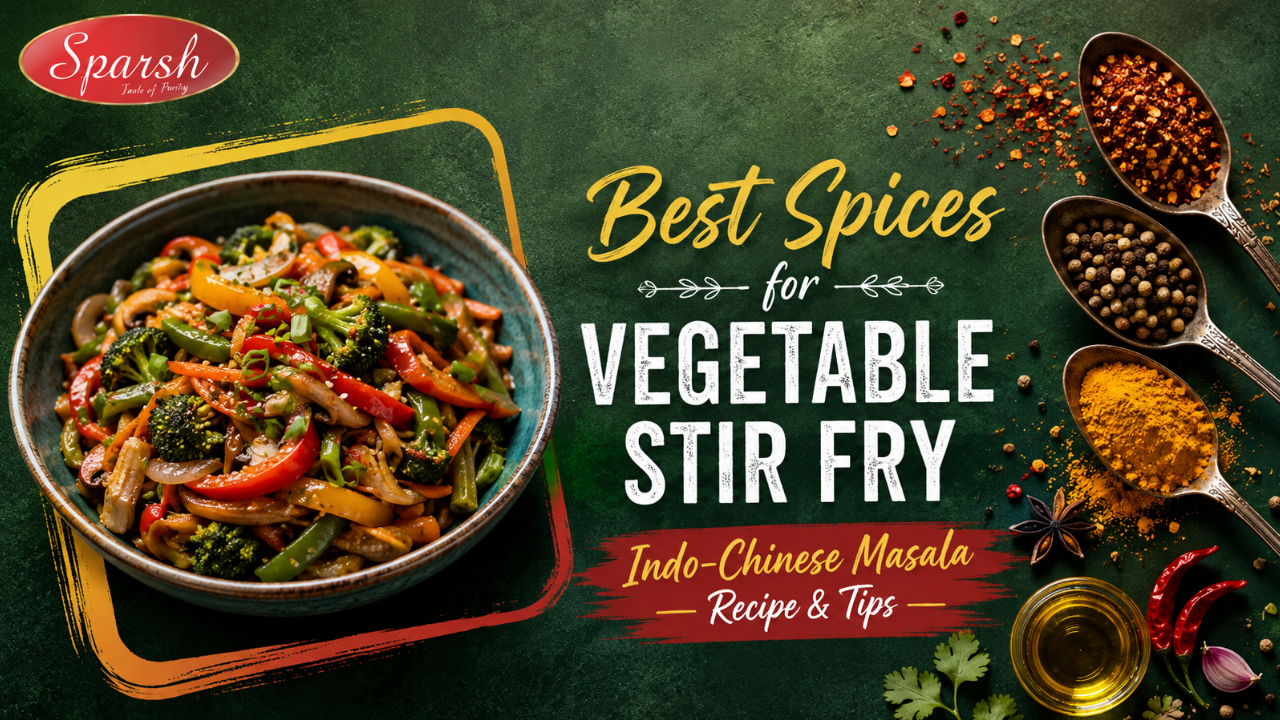
Best Spces for Vegetable Stir Fry | Indo-Chinese Masala Recipe and Tips
Vegetable stir fry is one of the most popular dishes in Indian homes today. It sits perfectly at the intersection of two great culinary worlds — the bold, smoky flavours of Indo-Chinese cooking and the aromatic depth of Indian spice tradition. A good vegetable stir fry is quick, colourful, nutritious, and deeply satisfying. But here is what separates an exceptional vegetable stir fry from a bland, watery disappointment: the spices.
The challenge most home cooks face is not knowing which vegetables to use or how to cut them. The challenge is selecting the best spices for vegetable stir fry and understanding how to layer them correctly to build that signature smoky, tangy, spicy Indo-Chinese flavour that restaurant dishes achieve but home cooking rarely does. Many people make stir fry that tastes flat — just soy sauce and chilli, or heavy-handed with one spice and nothing else. The result looks colourful but tastes one-dimensional and forgettable.
In this complete guide, we walk you through the best spices for vegetable stir fry, explain why each spice matters in an Indo-Chinese context, provide a step-by-step masala recipe with tips, and show you how to use quality products like Sparsh Masala to create vegetable stir fry that tastes like it came from your favourite Indo-Chinese restaurant. By the end, you will understand stir fry cooking at a deeper level and create dishes your family will actually request again and again.
Why Vegetable Stir Fry Needs the Right Spices
Stir fry is a high-heat, fast-cooking method. This means spices behave very differently than they do in slow-cooked curries or dal. Understanding this difference is the key to perfect Indo-Chinese stir fry.
Vegetables Are Naturally Mild
Most stir fry vegetables — capsicum, baby corn, mushrooms, broccoli, carrot, beans, cabbage — have relatively neutral flavours on their own. Just like lentils in dal, vegetables take on the character of whatever spices and sauces surround them. This is an advantage — it means a great spice blend can completely transform the dish — but it also means that without proper spicing, vegetable stir fry tastes of very little.
High Heat Changes How Spices Work
In stir fry cooking, the wok or pan is very hot — far hotter than in curry cooking. Spices added to a hot stir fry bloom and release their aromatic compounds within seconds. This means the sequence of adding spices matters enormously. Add them too early and they burn. Add them too late and they taste raw. The best spices for vegetable stir fry are those that perform well under high heat without bitterness.
Indo-Chinese Needs a Specific Spice Balance
Indo-Chinese cooking is a fusion style developed in Indian cities — particularly Kolkata, Mumbai, and Bengaluru — combining Chinese wok cooking techniques with Indian spice sensibilities. The flavour profile is simultaneously smoky, tangy, spicy, and slightly sweet. Achieving this balance requires knowing which Indian spices complement soy sauce, vinegar, and Chinese-inspired seasonings. This is where most home cooks go wrong — they use either pure Indian spices or pure Chinese seasonings instead of blending both thoughtfully.
Quality Spices Make an Immediate Difference
The difference between vegetable stir fry made with fresh, quality Indian spices and stir fry made with stale spice powder is immediately visible and tasteable. Fresh spices from Sparsh Masala are made from whole roasted spices, freshly ground. They retain their aromatic oils and volatile compounds that create the flavour complexity Indo-Chinese stir fry demands. Stale spices produce dull, flat results regardless of technique.
The Best Spices for Vegetable Stir Fry — Explained
Understanding each spice and its specific role in Indo-Chinese cooking helps you build better stir fry every time.
Black Pepper — The Heat Backbone
Black pepper is the single most important spice in Indo-Chinese vegetable stir fry. Unlike red chilli which gives sharp, frontal heat, black pepper provides a slow-building, deep warmth that runs through every bite. This is the spice that gives Indo-Chinese dishes their characteristic peppery depth. Use freshly cracked or coarsely ground Sparsh Masala Black Pepper Powder — add it at the end of cooking to preserve its volatile aromatic compounds. Half a teaspoon per serving of stir fry is the correct starting ratio.
Garam Masala — The Warmth Layer
A small amount of Sparsh Masala Garam Masala Powder added to Indo-Chinese stir fry bridges the gap between Indian spice tradition and Chinese cooking technique. It adds cinnamon warmth, cardamom brightness, and clove depth that lifts the entire dish. Use only a pinch — one quarter teaspoon per serving — added in the last 30 seconds of cooking. More than this and the stir fry tastes like curry. Less than this and you miss the layered warmth that distinguishes great Indo-Chinese cooking.
Ginger and Garlic — The Aromatic Foundation
No Indo-Chinese dish exists without ginger and garlic. These two aromatics form the aromatic foundation of every stir fry. Fresh ginger provides a sharp, clean heat that works differently from chilli — it is brighter and more citrusy. Fresh garlic provides depth and pungency. Sparsh Masala Ginger & Garlic Paste provides both in a convenient, ready-to-use form that delivers consistent flavour without the inconsistency of mincing by hand. Use one tablespoon of ginger garlic paste per two cups of vegetables — add it as the first ingredient to the hot oil so it blooms fully before the vegetables go in.
Red Chilli — The Colour and Heat
Red chilli powder or whole dried red chillies add both colour and heat to vegetable stir fry. In Indo-Chinese cooking, the chilli heat should be bold but not overwhelming — you should feel it but it should not mask the other flavours. Use Sparsh Masala red chilli powder — add it to the hot oil briefly before the vegetables for maximum colour extraction. The Byadgi chilli in Sparsh Masala products gives deep brick-red colour with moderate, rounded heat — ideal for stir fry where colour presentation matters.
Cumin — The Earthiness
A small amount of cumin seeds or Sparsh Masala Jeera Powder added at the beginning of cooking provides an earthy, warm base note that anchors the lighter Indo-Chinese flavours. Cumin in a stir fry is subtle — you will not identify it individually but you will notice its absence. One quarter teaspoon of cumin seeds added to hot oil at the very start, allowed to crackle for five seconds, is all you need.
Turmeric — The Colour Foundation
A small pinch of turmeric gives vegetable stir fry a warm golden undertone that makes the dish visually appealing and adds a gentle, earthy warmth. In stir fry, turmeric should be used very sparingly — one eighth teaspoon maximum — because too much turmeric makes the dish taste medicinal and turns the bright vegetable colours muddy. Add turmeric to the oil very briefly before the vegetables.
Coriander Powder — The Cooling Balance
Coriander powder adds a gentle, cooling sweetness that balances the heat of black pepper and red chilli in stir fry. It is a background spice in Indo-Chinese cooking — barely perceptible on its own but essential for balance. Use one quarter teaspoon of Sparsh Masala Coriander Powder added with the ginger garlic paste.
Asafoetida (Hing) — The Secret Depth
Just as asafoetida transforms dal curry, a tiny pinch of Sparsh Masala Hotel Special Hing added to the hot oil at the very beginning gives vegetable stir fry an umami depth that is difficult to identify but impossible to ignore. Many experienced Indo-Chinese home cooks in Karnataka add hing as their secret ingredient — and it works. One eighth teaspoon is sufficient. More than this becomes overpowering.
Ingredients for Best Spices for Vegetable Stir Fry
For the Vegetable Stir Fry Base
3 cups Quantity Mixed vegetables (capsicum, carrot, beans, baby corn, mushroom, broccoli)
1 medium Onion (quartered and layers separated)
3 tbsp Spring onion greens
3 tbsp choppedOil (sesame oil or refined oil)
SaltTo taste
For the Indo-Chinese Masala Spice Mix
1 tbsp Sparsh Masala Ginger & Garlic Paste
½ tsp Sparsh Masala Black Pepper Powder
¼ tsp Sparsh Masala Garam Masala Powder
⅛ tsp Sparsh Masala Hotel Special Hing
¼ tsp Sparsh Masala Jeera Powder
½ tsp Red chilli powder
⅛ tsp Turmeric powder
r¼ tsp Coriander powde
For the Indo-Chinese Sauce Base
1.5 tbsp Soy sauce
1 tsp Vinegar
1 tsp Green chilli sauce
1 tbsp in 3 tbsp water Cornflour mixed in water
½ tsp Sugar
3 tbsp Water
Step-by-Step Vegetable Stir Fry Recipe with Indo-Chinese Masala
Step 1 — Prepare and Cut All Vegetables First
Before turning on the heat, cut all vegetables into similar sized pieces — approximately 1 inch chunks. Uniform size ensures even cooking. Keep onion layers, capsicum strips, baby corn halves, broccoli florets, mushroom quarters, and carrot matchsticks ready in separate bowls. Stir fry cooking happens fast — there is no time to cut vegetables once the pan is hot. This preparation step is what professional cooks call mise en place and it is mandatory for good stir fry.
Step 2 — Mix the Sauce and Set Aside
In a small bowl, mix soy sauce, vinegar, green chilli sauce, sugar, and three tablespoons of water. Stir well until sugar dissolves. In a separate small cup mix cornflour with three tablespoons of water until smooth. Keep both bowls next to the stove. Having sauce ready before cooking begins is essential — stir fry happens in under five minutes and you will have no time to mix sauce mid-cook.
Step 3 — Heat the Pan to the Correct Temperature
This is the most critical step for authentic stir fry flavour. Place a wide, heavy-bottomed pan or wok on the highest flame available. Allow it to heat for two full minutes until it begins to smoke slightly. This is the temperature at which real stir fry wok cooking happens. Add three tablespoons of oil and swirl to coat the pan. The oil should shimmer immediately. This high-heat cooking is what creates the characteristic smoky flavour of restaurant Indo-Chinese food — called wok hei — that home cooking often misses simply because the heat is not high enough.
Step 4 — Bloom the Spices in Hot Oil
Add one eighth teaspoon of Sparsh Masala Hotel Special Hing to the hot oil immediately. Stir once. Within three seconds add the cumin — it will crackle immediately. Then add one eighth teaspoon of turmeric and one quarter teaspoon of red chilli powder. Stir quickly for five seconds. The oil will turn deep orange-red from the chilli. This colour will transfer to every vegetable in the stir fry. Do not let the spices burn — the entire spice blooming step takes less than ten seconds on high heat.
Step 5 — Add Ginger Garlic and Aromatics
Add one tablespoon of Sparsh Masala Ginger & Garlic Paste to the spice-infused hot oil. The paste will sizzle aggressively — this is correct. Stir continuously for twenty to thirty seconds until the raw ginger garlic smell cooks off and it becomes fragrant and golden. Add one quarter teaspoon of coriander powder at this stage. The entire aromatics step takes approximately thirty seconds. Do not let the paste brown too dark or it will turn bitter.
Step 6 — Add Vegetables in the Correct Order
Add harder vegetables first — carrot and beans go in first. Toss vigorously with the spiced oil for one minute on high heat. Add baby corn and broccoli next — toss for thirty seconds. Add capsicum, mushroom, and onion last — these need the least cooking time. Toss everything together vigorously for one minute. The vegetables should be slightly charred at the edges from the high heat — this char is the flavour. Do not cover the pan — covering traps steam and makes vegetables soggy instead of stir-fried.
Step 7 — Add the Sauce
Pour the prepared soy sauce mixture over the vegetables. Toss immediately to coat every piece. The sauce will bubble and reduce quickly on high heat. Stir and toss for thirty seconds. Pour the cornflour mixture in slowly while stirring continuously. The sauce will thicken within thirty seconds to a glossy coating that clings to every vegetable. If too thick add a splash of water. If too thin cook for another thirty seconds.
Step 8 — Final Spice Finish
Reduce heat to medium. Add one quarter teaspoon of Sparsh Masala Garam Masala Powder and one half teaspoon of Sparsh Masala Black Pepper Powder. Toss once to combine. These two spices are added at the end deliberately — garam masala and black pepper both lose their aromatic compounds quickly at high heat, so adding them at the end preserves their full flavour impact. Add salt to taste — remember soy sauce is already salty so taste before adding more.
Step 9 — Garnish and Serve Immediately
Remove from heat. Scatter spring onion greens over the top. Serve immediately — stir fry waits for no one. Vegetables continue cooking from residual heat even after the flame is off. Serve with fried rice, noodles, or as a standalone dish.
Total cooking time: 8–10 minutes
(after all vegetables are prepped)
Why Use Sparsh Masala for Your Vegetable Stir Fry
Sparsh Masala is a Karnataka-based spice brand committed to quality and purity. Every Sparsh Masala product is made from carefully selected whole spices — Byadgi chillies from Haveri district, Marathi Mokku, and roasted dried coconut. There are zero artificial colours or preservatives in any product. This commitment means your stir fry gets authentic flavour without unwanted additives.
When making Indo-Chinese vegetable stir fry, the Indian spice components — black pepper, garam masala, hing, and ginger garlic paste — are what differentiate a genuinely flavourful Indo-Chinese dish from a simple Chinese-style stir fry. Sparsh Masala’s freshly ground spices deliver the aromatic intensity that this fast, high-heat cooking method demands. Sparsh Masala Garam Masala Powder adds the warming Indian spice finish. Sparsh Masala Hotel Special Hing provides the depth. Sparsh Masala Black Pepper Powder delivers the heat backbone that defines Indo-Chinese cooking.
Tips for Perfect Vegetable Stir Fry Every Time
Use the highest heat available. The biggest mistake home cooks make is cooking stir fry on medium heat. Medium heat steams vegetables. High heat stir-fries them. The difference in texture and flavour is enormous.
Cut vegetables uniformly. Unevenly cut vegetables cook unevenly — some pieces are overcooked while others remain raw. Take time to cut everything to similar size.
Do not overcrowd the pan. Adding too many vegetables at once drops the pan temperature dramatically, causing steaming instead of stir-frying. Cook in batches if necessary for large quantities.
Have everything ready before cooking begins. Stir fry cooking happens in under ten minutes. There is no time to find ingredients mid-cook. Complete all preparation before heating the pan.
Add black pepper and garam masala at the end. Both these spices lose their aroma under prolonged high heat. Always add them in the final thirty seconds.
Do not cover the pan during stir fry. Covering traps steam and makes vegetables limp and soggy. Keep the pan open throughout cooking.
Use fresh vegetables. Stir fry showcases vegetable quality because cooking time is short. Fresh crisp vegetables produce far better results than old, limp ones.
Balance your sauces carefully. Soy sauce is very salty. Vinegar is very acidic. Both are powerful. Start with less than you think you need and adjust. The Indian spices should be tasted alongside the sauces, not overwhelmed by them.
Frequently Asked Questions
1. What are the best spices for vegetable stir fry Indo-Chinese style?
The best spices for vegetable stir fry Indo-Chinese style are black pepper, garam masala, ginger and garlic, red chilli, cumin, turmeric, coriander powder, and asafoetida. Black pepper is the most important — it provides the slow-building heat that defines Indo-Chinese cooking. Garam masala bridges Indian and Chinese flavour profiles. Ginger garlic forms the aromatic base. Asafoetida adds restaurant-style depth. These spices work together with soy sauce and vinegar to create the complete Indo-Chinese flavour profile. Sparsh Masala products deliver these spices in their freshest, most flavourful form.
2. Can I use Indian masala powder for Indo-Chinese stir fry?
Yes, Indian masala powders work beautifully in Indo-Chinese stir fry when used correctly. The key is understanding which Indian spices complement the Chinese sauce base. Garam masala, black pepper, and cumin all work very well with soy sauce and vinegar. Heavier masalas like sambar powder or bisibele bath powder are too complex for stir fry and will make it taste like curry. Use Sparsh Masala Garam Masala Powder and Black Pepper Powder specifically for the best results in Indo-Chinese cooking.
3. Why does my vegetable stir fry turn soggy at home?
Soggy stir fry almost always comes from one of three causes. First, the heat is too low — stir fry requires the highest heat your stove can produce. Medium heat steams vegetables and makes them limp. Second, the pan is overcrowded — too many vegetables at once drops the temperature and causes steaming. Cook in batches. Third, the pan was covered during cooking — always cook stir fry with the pan open. Covering traps steam and destroys the crisp texture. Follow the high-heat, open-pan method in this recipe for perfectly crisp stir fry every time.
4. How much black pepper should I use in vegetable stir fry?
Use half a teaspoon of Sparsh Masala Black Pepper Powder per three cups of vegetables as a starting point for medium heat. Black pepper heat is slower-building than chilli heat — you will not feel the full effect immediately. Taste after thirty seconds and adjust. Always add black pepper at the end of cooking after removing from high heat — black pepper added too early in high-heat cooking can turn bitter. For those who prefer milder heat start with one quarter teaspoon and increase gradually.
5. What vegetables work best for Indo-Chinese stir fry?
The best vegetables for Indo-Chinese stir fry are capsicum (all colours), baby corn, broccoli, mushrooms, carrot, french beans, spring onion, and cabbage. These vegetables all have firm textures that hold up to high heat without becoming mushy. They also have relatively neutral flavours that absorb the Indo-Chinese spice and sauce blend beautifully. Avoid vegetables with high water content like tomatoes, zucchini, or cucumber — these release water during high-heat cooking, making the stir fry watery instead of dry and saucy.
Conclusion
The best spices for vegetable stir fry are those that bridge Indian aromatic tradition with Indo-Chinese cooking technique. Black pepper provides the heat backbone, garam masala adds Indian warmth, ginger garlic forms the aromatic base, and asafoetida delivers the depth that makes home stir fry taste like restaurant cooking. When these Indian spices are combined with soy sauce, vinegar, and the correct high-heat technique, the result is vegetable stir fry that is smoky, tangy, spicy, deeply flavourful, and completely satisfying.
Quality spices make the difference. Sparsh Masala’s freshly ground spice range — from Black Pepper Powder to Garam Masala to Hotel Special Hing — delivers the authentic, potent flavour that Indo-Chinese cooking demands. This vegetable stir fry masala recipe and tips guide gives you everything you need to make perfect Indo-Chinese stir fry at home every single time. Start with this recipe, master the spice ratios, then experiment with different vegetables and heat levels. Your family will be requesting this dish every week.
👉 Shop Sparsh Masala Spice Range for Authentic Indo-Chinese Cooking →