
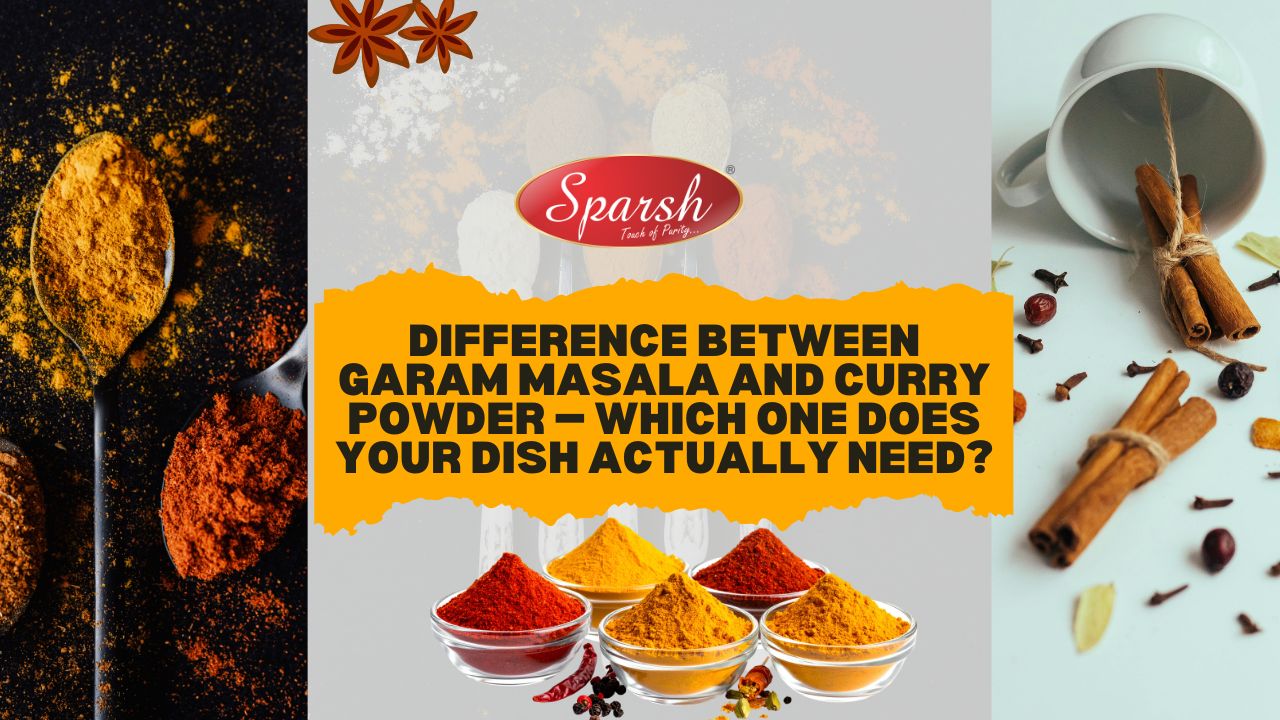
Difference Between Garam Masala and Curry Powder — Which One Does Your Dish Actually Need?
If you have ever stood in your kitchen holding two spice packets — one labelled garam masala and one labelled curry powder — and wondered which one to add, you are not alone. This is one of the most common questions in Indian cooking, and the confusion is completely understandable. Both are spice blends. Both smell incredible. Both show up in recipes without much explanation. But they are fundamentally different in composition, flavour, heat level, and the way they are used in cooking.
The difference between garam masala and curry powder is not just a matter of preference — using the wrong one at the wrong time can completely change the outcome of your dish. In this guide, we break down everything you need to know: what each blend contains, how they are made, when to use them, and which dishes call for which spice.
What Is Garam Masala?
Garam masala is a North and South Indian spice blend whose name translates literally to “hot spices” — but not hot in the sense of chilli heat. The word “garam” refers to warming spices that raise the body’s internal temperature according to Ayurvedic tradition. Think cinnamon, cloves, black cardamom, and black pepper — spices that create a deep, warming sensation rather than a sharp burn on the tongue.
Garam masala is almost always added at the end of cooking, or used as a finishing spice, because its aromatic compounds are volatile. High heat over a long period destroys the fragrance that makes garam masala valuable. A pinch added in the last two minutes of cooking does far more work than the same pinch added at the beginning.
What Goes Into Garam Masala?
The exact recipe varies by region and by brand, but a traditional garam masala will always contain a combination of the following:
- Black and green cardamom
- Cinnamon or cassia bark
- Cloves
- Black pepper
- Cumin
- Coriander
- Bay leaves
- Nutmeg or mace
- Star anise (in some regional versions)
Sparsh Masala’s Garam Masala follows a traditional Karnataka formulation — roasted, blended, and packed without any artificial additives or flavour enhancers. You can explore it on the Sparsh Garam Masala product page.
Notice what is not in that list: turmeric, chilli powder, or fenugreek. Those belong to a different category of spice blends entirely — which brings us to curry powder.
What Is Curry Powder?
Curry powder is not a traditional Indian spice blend. It is a British-era standardisation of Indian flavours — an attempt to recreate the complex taste of Indian curries in a single, shelf-stable mix that could be exported and used without any knowledge of individual spices. The result is a blend that is recognisable, but broad — designed to approximate Indian flavour rather than represent any specific dish or region.
A standard curry powder contains turmeric (which gives it the yellow colour), along with coriander, cumin, chilli, fenugreek, and sometimes mustard seed. It is meant to be added early in the cooking process — usually with onions or after the tomatoes — so that the raw spice flavour has time to cook out.
What Goes Into Curry Powder?
A typical curry powder blend contains:
- Turmeric (the dominant ingredient — responsible for the yellow colour)
- Coriander seed
- Cumin
- Red chilli or cayenne
- Fenugreek
- Mustard seed (in some versions)
- Ginger powder
- Black pepper
- Cardamom (in smaller amounts)
The proportions vary widely between brands and countries. British curry powder, Madras curry powder, and Sri Lankan curry powder are all quite different from one another. None of them are the same as the spice blends used in traditional Karnataka or South Indian home cooking.
The Key Differences Between Garam Masala and Curry Powder
Now that you know what each blend contains, here is a clear side-by-side breakdown of how they differ in every practical way.
1. Primary Flavour Profile
Garam masala is warm, complex, and aromatic. The flavour comes from roasted whole spices with high essential oil content — cardamom, cloves, cinnamon, black pepper. It smells fragrant and deep, almost sweet in some formulations.
Curry powder is earthy and slightly sharp, with turmeric as the dominant note. The fenugreek adds a slight bitterness, the chilli adds heat, and the overall impression is rounded but one-dimensional compared to garam masala.
2. Colour
Garam masala has no fixed colour — it ranges from light brown to dark brown depending on the spice ratio. It does not colour a dish significantly.
Curry powder is yellow to golden-orange because turmeric is its primary ingredient. It will colour everything it touches — your dish, your pan, and your hands.
3. When to Add It During Cooking
This is the most important practical difference.
Garam masala is a finishing spice. Add it in the last one to two minutes of cooking, after the heat is turned down, or even after the dish is plated. Adding it too early destroys the volatile aromatic compounds that make it special. If you want to understand the correct technique in detail, our post on how to use garam masala correctly explains exactly when and how much to add.
Curry powder is a base spice. Add it early — typically after your onions are softened and before you add tomatoes or liquid. It needs time and heat to cook through and lose its raw, slightly bitter edge.
4. Heat Level
Garam masala has warmth but very little chilli heat. The warmth comes from black pepper and cloves — a deep, spreading sensation rather than a sharp sting. It is suitable for dishes you want to be fragrant and full-bodied without being spicy.
Curry powder typically contains chilli or cayenne and delivers actual heat, though the level varies by brand. Madras curry powder is significantly hotter than standard curry powder.
5. Role in the Dish
Garam masala layers complexity on top of an already cooked dish. Think of it as the final brushstroke — it ties the flavours together and adds an aromatic top note.
Curry powder builds the flavour base from the ground up. It goes in early and saturates the dish — the turmeric, coriander, and fenugreek cook into the sauce and become part of the fundamental flavour rather than sitting on top of it.
6. Regional Identity
Garam masala exists in every major Indian regional cuisine — North Indian, South Indian, Mughlai — though the specific formulation changes. It is a genuinely Indian spice blend with a long culinary history.
Curry powder, as a fixed standardised blend, is largely a Western invention. In authentic Indian cooking, no recipe calls for “curry powder.” Each cuisine has its own specific spice blends — sambar powder, bisibele bath powder, rasam powder — that do what curry powder attempts to do, but with much more precision. Read our complete Karnataka sambar powder guide for an example of how a real regional spice blend works.
Can You Substitute One for the Other?
In short — no. Substituting garam masala for curry powder or vice versa will give you a noticeably different dish.
If a recipe calls for curry powder and you add garam masala instead, your dish will lack the turmeric base colour and the earthy fenugreek note. It will taste more fragrant but less grounded.
If a recipe calls for garam masala and you use curry powder instead, the turmeric will colour everything yellow, the dish will taste sharp and earthy rather than aromatic, and the fenugreek bitterness may overpower the other flavours.
The only situation where a partial substitution works is if you are improvising and understand the role each spice plays in the recipe. Even then, it is better to understand the correct spice and use it correctly than to work around a gap.
Which Dishes Use Garam Masala and Which Use Curry Powder?
Dishes That Use Garam Masala
- Chicken and mutton curries — added as a finishing spice in the last two minutes
- Dal makhani — stirred in just before serving
- Biryani — added to the rice layer or the meat marinade
- Paneer dishes — added after the sauce is cooked through
- Aloo gobi and similar vegetable dishes — final seasoning
Our bisibele bath recipe from Karnataka shows how a regional masala blend functions differently from both garam masala and curry powder — worth reading if you want to understand South Indian spice logic.
Dishes That Use Curry Powder
- British-style Indian curries
- Curry-flavoured soups and stews in Western cooking
- Curry rice or curry noodles in Southeast Asian-influenced dishes
- Marinades for grilled dishes where the turmeric adds colour
In authentic South Indian or Karnataka cooking, neither “curry powder” nor a single catch-all spice blend is used. Different dishes each have a specific masala — sambar powder for sambar, rasam powder for rasam, vangibath powder for vangibath. Each is formulated precisely for that dish. If your rasam has been turning watery or losing its flavour, our post on why rasam turns watery explains why a specific rasam powder always outperforms a generic curry powder.
How Sparsh Masala Approaches Both
At Sparsh Masala, the philosophy is that every dish deserves a masala built specifically for it — not a generic all-purpose blend. This is why the product range includes individual, dish-specific masalas like Sambar Powder, Rasam Powder, Bisibele Bath Powder, and Vangibath Powder alongside a traditional Garam Masala.
All Sparsh Masala products are made with authentic Karnataka ingredients — including Byadgi chillies from Haveri district for natural colour, roasted dried coconut for depth, and Marathi Mokku (Stone Flower) in the Bisibele Bath Powder. No artificial colours, no preservatives, no shortcuts.
If you have been using a generic curry powder for South Indian cooking and wondering why your sambar and rasam never taste right — the spice blend is the reason. Explore the full Sparsh Masala veg masala range to see what dish-specific masalas can do for your cooking. For non-vegetarian cooking, the non-veg masala range including Chicken Kabab Masala is available on the same website.
FAQs About Difference Between Garam Masala and Curry Powder
No. Garam masala and curry powder are two different spice blends with different ingredients, different flavour profiles, and different roles in cooking. Garam masala is an aromatic finishing spice made from warming whole spices like cardamom, cloves, and cinnamon. Curry powder is a base spice blend dominated by turmeric, coriander, and fenugreek, designed to be cooked in at the beginning of the recipe. Using one in place of the other will noticeably change the flavour and colour of the dish.
Curry powder is generally hotter in terms of chilli heat, because it typically contains red chilli or cayenne pepper as a key ingredient. Garam masala is warming rather than spicy — the heat comes from black pepper and cloves and creates a deep, spreading warmth rather than a sharp burn. If you are cooking for people who are sensitive to heat, garam masala is the gentler option.
You can, but the result will be different. Garam masala has no turmeric, so your dish will not develop the yellow colour that curry powder creates. It also lacks fenugreek and coriander in the same proportions, so the earthy base flavour will be absent. The dish will taste more fragrant and aromatic but will lack the grounded depth of a curry-powder-based recipe. Adjust other spices accordingly if you make this substitution.
Always add garam masala at the end of cooking — in the last one to two minutes, after the heat is turned down. The aromatic compounds in garam masala are volatile and break down quickly under sustained heat. Adding it early will result in a flat, muted flavour with none of the fragrance that makes garam masala worth using. See our dedicated post on how to use garam masala correctly for step-by-step guidance.
No. Traditional South Indian and Karnataka cooking does not use a generic “curry powder.” Each dish has its own specific spice blend — sambar powder, rasam powder, bisibele bath powder, vangibath powder — each formulated with the precise combination of spices that dish requires. These blends are far more specific and flavourful than a generic curry powder. This is exactly the approach Sparsh Masala follows — every product in the range is built for a specific dish, not as an all-purpose substitute.
CONCLUSION
The difference between garam masala and curry powder comes down to this: garam masala is an aromatic finishing spice added at the end of cooking for fragrance and complexity. Curry powder is a base seasoning added early in cooking to build colour and earthiness. They are not interchangeable, and understanding when to use each one will immediately improve the quality of your cooking.
For South Indian and Karnataka cooking specifically, neither of these is the right answer for most dishes — a dish-specific masala like sambar powder, rasam powder, or bisibele bath powder will always produce a better result. That precision is exactly what Sparsh Masala is built on.