
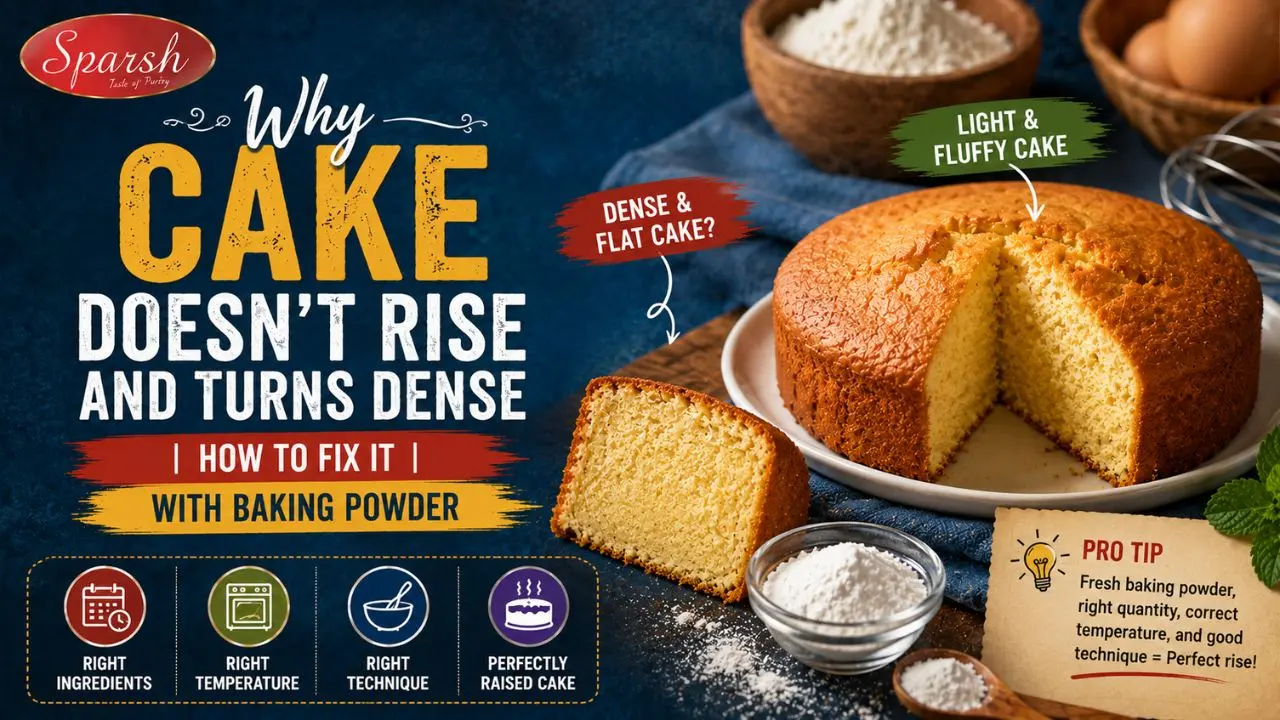
Why Cake Doesn't Rise and Turns Dense | How to Fix It With Baking Powder
Why cake doesn’t rise and turns dense almost always comes down to one of six fixable mistakes, and none of them require a fancy oven or a culinary degree to correct. If you’ve pulled a cake out looking flat, heavy, or sunk in the middle after following the recipe exactly, the problem usually isn’t the recipe. It’s one small step that got rushed or skipped.
We get this question more than almost any other baking question at Sparsh Masala, mostly from home bakers switching from eggs to an eggless batter, or from atta to maida, and wondering why the texture changed. The fix, most of the time, starts with understanding what your leavening agent is actually doing in the bowl.
Pro Tip: If your cake looks fine going into the oven but sinks in the middle coming out, the issue is almost never the recipe. It’s timing, oven temperature, or old baking powder.
1. Baking powder that's lost its power
Baking powder loses strength over time, especially in humid Indian kitchens where moisture creeps into the tin even when it’s sealed. If your baking powder is older than 6 months, it may already be half as effective as the day you bought it.
Success Tip: Test it before you bake. Drop half a teaspoon into warm water. If it fizzes immediately and vigorously, it’s still active. If it barely bubbles, replace it.
2. Wrong quantity for the flour used
Different flours need different amounts of leavening. Whole wheat (atta) is denser than maida and needs slightly more baking powder to rise the same way. Using a maida-based recipe’s exact measurements with atta is one of the most common reasons home bakers get a flat, heavy cake.
3. Overmixing the batter
Once the wet and dry ingredients meet, every extra stir knocks air out of the batter and overdevelops the gluten, especially in wheat-based batters. Overmixed batter bakes into a tight, dense crumb instead of a light one.
4. Opening the oven door too early
cake sets its structure in the first 15-20 minutes of baking. Opening the door before that lets cold air in, drops the oven temperature suddenly, and can cause the center to collapse.
Warning Tip: Resist checking your cake before the two-thirds mark of the total bake time. Use the oven light and glass door instead of opening it.
5. Batter left standing too long before baking
Baking powder starts reacting the moment it hits liquid. If your batter sits on the counter for 15-20 minutes before going into the oven, whether because the oven wasn’t preheated or you got distracted, a good portion of the rise has already happened and escaped before baking even starts.
6. Wrong oven temperature
An oven that runs cooler than its dial suggests, which is common with basic home ovens, bakes the cake too slowly. The structure sets before the rise finishes, leaving a dense, gummy center.
Ingredients That Affect Rise
| Ingredient | Role in Rising | Common Mistake |
|---|---|---|
| Baking powder | Provides both lift reactions (wet + heat) | Using expired or old stock |
| Baking soda | Needs an acidic ingredient to activate | Using it alone with no acid, like curd or lemon |
| Flour type | Wheat needs more leavening than maida | Same quantity used across both flour types |
| Fat (oil/butter) | Traps air bubbles during creaming | Under-creaming or using cold butter |
| Liquid ratio | Activates the leavening agent | Too little liquid, batter too stiff to rise |
Baking soda and baking powder are both leavening agents, but they aren’t interchangeable — learn more about the difference here: https://www.healthline.com/nutrition/baking-soda-vs-baking-powder
(Elementor tip: rebuild this as a Table widget for clean formatting — pasted text tables often break.)
How Much Baking Powder Do You Actually Need?
The standard ratio is 1 teaspoon of baking powder per cup of flour for maida, and closer to 1.25 teaspoons per cup for whole wheat flour, since atta is heavier and needs more lift to match the same rise.
Sparsh Baking Powder is a double-acting formula, which means it reacts twice: once when it meets liquid at room temperature, and again once it hits oven heat. That second reaction is what actually carries most home-baked cakes through to a proper rise, since the first reaction alone isn’t enough to hold a full-sized cake up during baking.
Pro Tip: If you’re baking at high altitude or in a very humid kitchen, add a quarter teaspoon less baking powder than the recipe calls for. Extra humidity in the air already adds moisture the recipe didn’t account for.
Step by Step: How to Get a Cake That Actually Rises
Getting a consistent rise comes down to controlling five variables, not one.
- Check your baking powder is fresh using the warm water fizz test before you start. (2 min)
- Preheat the oven fully for at least 10 minutes before the batter is ready to go in. (10 min)
- Sift the dry ingredients, including Sparsh Baking Powder, together before adding wet ingredients. This distributes it evenly instead of leaving pockets. (3 min)
- Cream the fat and sugar properly until pale and fluffy, which traps the air bubbles the baking powder needs to expand. (4-5 min)
- Fold, don’t stir, once the dry ingredients go in. Mix only until no flour streaks remain. (1-2 min)
- Pour and bake immediately. Don’t let the batter sit once the baking powder has met the liquid. (0 min wait)
- Don’t open the oven for at least the first two-thirds of the total bake time. (varies by recipe)
- Test with a skewer in the center only once the cake looks set and golden at the edges.
Frequently Asked Questions
Why does my cake rise in the oven but sink after I take it out?
This usually means the cake was underbaked in the center. The structure hadn’t fully set, so it collapses once it cools and the trapped air escapes. Bake a few minutes longer next time and test with a skewer at the center.
Can I use baking soda instead of baking powder for a cake?
Not directly. Baking soda needs an acidic ingredient like curd, buttermilk, or lemon juice to activate, while baking powder already contains the acid it needs. Swapping them without adjusting the recipe usually results in a flat or bitter-tasting cake.
How do I know if my baking powder has expired?
Drop half a teaspoon into warm water. Fresh baking powder fizzes immediately and strongly. If it barely reacts, it’s lost most of its lifting power and should be replaced.
Does whole wheat (atta) cake need more baking powder than a maida cake?
Yes. Atta is heavier and denser than maida, so it typically needs about 25% more baking powder to achieve a similar rise and soft texture.
Why does my eggless cake turn out denser than an egg-based one?
Eggs help trap air during mixing, which supports the rise. Without eggs, the baking powder is doing more of the work alone, so using a properly measured double-acting baking powder like Sparsh Baking Powder becomes more important, not less.
Can too much baking powder ruin a cake?
Yes. Too much causes the cake to rise too fast, then collapse as it can’t hold the structure, often leaving a bitter, metallic aftertaste. Stick to the standard ratio of about 1 teaspoon per cup of flour.
Conclusion
Why cake doesn’t rise and turns dense is rarely a mystery once you look at it step by step. Fresh baking powder, the right quantity for your flour, a fully preheated oven, and a batter that goes in without delay solve most dense-cake problems on their own. With Sparsh Baking Powder doing the double-acting lift your batter needs, the rest comes down to technique you can fix on your very next bake.
Shop Sparsh Baking Powder → link to /product/baking-powder/
Explore More Sparsh Recipes → link to /category/sparsh-recipes/
Recipe and baking guidance developed by the Sparsh Masala kitchen team, Karnataka. Last updated August 11, 2026.