
Best Sambar Masala in Karnataka — What to Look For and Why Sparsh Masala Delivers
Sambar is the foundation of South Indian cooking. It shows up on the breakfast table with idli and dosa, at lunch with rice, and even as a base for upma and pongal variations. Given how central sambar is to daily meals across Karnataka, the quality of your sambar masala is not negotiable. A weak, poorly balanced sambar powder will flatten every dish it touches. A good one — made with the right ingredients and proper roasting — transforms even the simplest dal and vegetable combination into something deeply satisfying.
So what makes the best sambar masala in Karnataka? It comes down to three things: ingredient authenticity, roasting technique, and regional formulation. In this guide, we break down what separates an average sambar powder from an exceptional one, which ingredients matter most, and why more Karnataka kitchens are switching to Sparsh Masala for their daily sambar.
What Makes a Sambar Masala "Good" vs "Great"
Most people assume all sambar powders are roughly the same — a mix of roasted spices ground into powder. The reality is far more specific. A great sambar masala balances six distinct flavour components: heat, colour, aroma, tang-compatibility, body, and aftertaste. Miss any one of these and the sambar tastes incomplete, no matter how carefully you cook it.
The Six Flavour Components of Sambar Masala
Heat — comes from the variety of red chilli used. Byadgi chilli from Haveri district gives a mild, rounded heat, while Guntur chilli produces a sharper, more overpowering spice level. The best sambar masala in Karnataka traditionally uses Byadgi chilli.
• Colour — should come naturally from Byadgi chilli, not synthetic food dye. If your sambar appears orange-yellow instead of a rich red-brown, the masala either contains too little chilli or relies on artificial colouring.
• Aroma — created by properly roasted coriander seeds, fenugreek, and cumin. Under-roasted spices taste raw and bitter, while over-roasted spices become burnt and acrid. Correct roasting is what separates homemade-quality sambar powder from mass-produced blends.
• Tang compatibility — sambar depends on tamarind for its sourness. A poorly balanced sambar powder either gets overwhelmed by the tamarind or clashes with it. Roasted coconut (copra) bridges this gap by softening the tang and rounding out the flavour.
• Body — refers to the richness and depth of the sambar. Thin or watery sambar often indicates a masala blend lacking roasted coconut. A well-balanced powder gives the sambar proper texture and fullness.
• Aftertaste — a good sambar masala leaves a clean, warm finish with slight sweetness from coriander and coconut. Poor-quality powders often leave bitterness from excess fenugreek or burnt spices, or a chemical aftertaste from preservatives and artificial flavour enhancers.
The best sambar masala in Karnataka gets all six elements right. That is the standard Sparsh Masala is built around.
The Core Ingredients — What Should Be in Every Sambar Powder
If you flip over a sambar masala packet and read the ingredient list, this is what should be there — and in roughly this order of prominence:
Essential Ingredients
• Coriander seeds (dhania) — the base of every sambar powder; provides the dominant aroma and sweetness
• Byadgi chilli — gives natural colour and mild heat; authentic Karnataka sambar powder uses Byadgi instead of generic red chilli
• Roasted dried coconut (copra) — adds body and richness, and balances the sharpness of tamarind; this is what separates South Indian sambar powder from many North Indian spice blends
• Chana dal (Bengal gram) — roasted and ground to add nuttiness and thickening power
• Toor dal — used similarly to chana dal, sometimes in combination
• Fenugreek seeds (methi) — used sparingly for bitterness balance; too much can make the sambar taste medicinal
• Cumin seeds (jeera) — adds an earthy base note
• Black pepper — contributes mild heat and aroma, complementing the Byadgi chilli
• Curry leaves — dried and powdered; traditional in Karnataka-style sambar powder
• Asafoetida (hing) — enhances the flavour of dal and vegetables
What Should NOT Be in Sambar Powder
• Artificial food colour (listed as “permitted food colour,” E110, E120, or similar)
• Synthetic flavour enhancers or MSG
• Preservatives such as sodium benzoate
• Excessive salt — good sambar powder is usually salt-free or very low in salt, since salt is added separately during cooking
• Turmeric in large quantities — a small amount is fine, but turmeric-heavy sambar powder often indicates a cheap, filler-heavy blend.
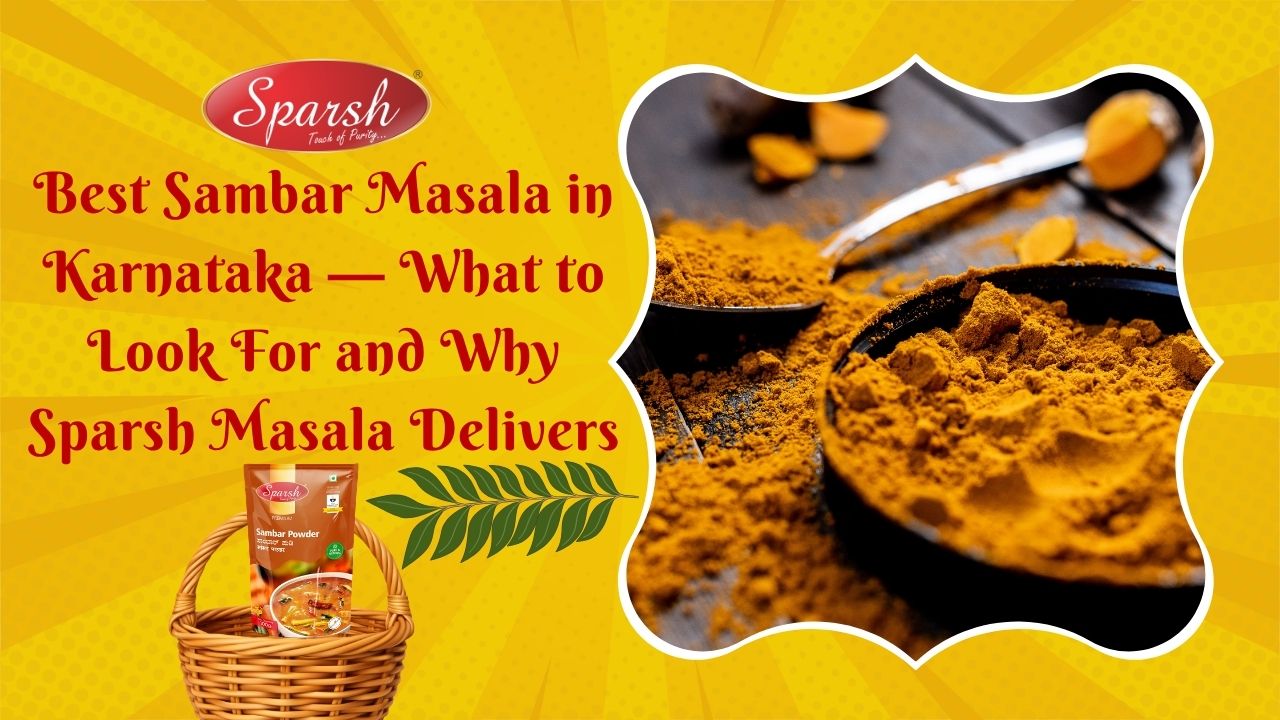
Sparsh Sambar Powder contains zero artificial additives. Every ingredient is whole, roasted, and ground — nothing synthetic, nothing hidden. You can see the full ingredient breakdown on the Sparsh Sambar Powder product page.
Why Byadgi Chilli Is Non-Negotiable for Authentic Karnataka Sambar
If there is one ingredient that separates authentic Karnataka sambar masala from generic versions, it is Byadgi chilli. Grown in the Haveri, Dharwad, and Gadag districts of northern Karnataka, Byadgi chilli has a unique combination of deep natural colour, mild heat, and rich aroma that no other chilli variety can replicate.
Byadgi chilli contains exceptionally high levels of natural pigments (capsanthin and capsorubin) which give sambar its signature dark red-brown colour. When you see a sambar that looks pale or orange, the masala powder either has very little Byadgi chilli or none at all — replaced instead with cheaper chilli varieties and synthetic dyes.
At Sparsh Masala, Byadgi chillies are sourced directly from Haveri district. This is a non-negotiable part of the formulation. For a deep dive into why this chilli variety matters so much, read our complete guide on Byadgi chilli Karnataka.
Roasted Coconut (Copra) — The Ingredient Most Brands Skip
Walk into any supermarket and pick up five different sambar powder packets. Check the ingredient lists. Chances are, three or four of them will not list roasted coconut at all. This is the single biggest quality compromise in mass-market sambar powders — and it is why store-bought sambar often tastes thin, sharp, and one-dimensional compared to homemade versions.
Roasted dried coconut (copra) does two critical things:
- Adds body and richness — the natural fat in coconut creates a fuller, rounder mouthfeel and helps the spices coat the vegetables and dal properly
- Balances tamarind sharpness — the slight sweetness of roasted coconut softens the acidity of tamarind, preventing the sambar from tasting too sour or too harsh
Copra also helps carry the fat-soluble pigments from Byadgi chilli throughout the dish, which is why coconut-based sambar powders produce a deeper, more even colour. Our post on why sambar tastes sour explains what happens when this balance is missing.
Sparsh Sambar Powder includes roasted dried coconut in every batch. It is one of the defining ingredients of the formulation — and one of the main reasons the flavour profile is noticeably different from other brands.
How to Identify a High-Quality Sambar Masala
When you are standing in front of a shelf full of sambar powder options, here is how to separate the good from the mediocre:
Check the Ingredient List
• Byadgi chilli should be listed by name, not simply as “red chilli”
• Roasted coconut or copra should appear within the first five ingredients
• No artificial colour, preservatives, or MSG
• Ingredients should be clearly specified — such as coriander, fenugreek, and cumin — rather than vague labels like “spices” or “condiments”
Look at the Colour
- Good sambar powder is dark reddish-brown, not bright orange or yellow
- The texture should appear slightly coarse rather than perfectly fine and uniform, which can indicate industrial processing or additives
Smell It
• A fresh, roasted aroma should be noticeable — especially coriander, coconut, and gentle warmth from the chilli
• There should be no chemical, stale, or musty smell
• The aroma should feel layered and balanced, not flat or one-dimensional
Check the Brand Transparency
- Does the brand mention where the Byadgi chilli is sourced from?
- Do they explain their roasting process?
- Is there a clear “no artificial additives” claim on the packaging?
Sparsh Masala meets all of these criteria. The sourcing, roasting, and formulation process is transparent — Byadgi chilli from Haveri, roasted coconut, zero preservatives. You can explore the reasoning behind this approach in our post on how Sparsh Masala elevates home cooking.
Sparsh Sambar Powder — Why It Is the Best Sambar Masala in Karnataka
Sparsh Sambar Powder is formulated specifically for Karnataka-style sambar. It is not a generic South Indian sambar powder adapted for mass production. It is built around the regional flavour profile that Karnataka kitchens expect: deep colour from Byadgi chilli, body from roasted coconut, balanced heat, and clean aftertaste.
What Makes Sparsh Sambar Powder Different
- Authentic Byadgi chilli from Haveri district — sourced directly rather than through middlemen
- Roasted dried coconut (copra) included in every batch for richness and balance
- No artificial colour or preservatives — the red colour comes entirely from natural ingredients
- Traditional roasting process — spices are roasted in small batches to preserve aroma
- Karnataka-specific formulation — designed for the way sambar is traditionally cooked in Karnataka homes
You can order directly from the Sparsh Sambar Powder product page, or find it on Amazon India and BigBasket.
For a complete breakdown of how to use sambar powder correctly — including the right quantity, when to add it, and how to avoid common mistakes — read our full “Sambar Powder Karnataka Complete Guide.”
How to Use Sambar Powder Correctly for Maximum Flavour
Step-by-Step Sambar Powder Usage
- Cook your dal and vegetables first until the dal is fully soft and the vegetables are tender.
- Prepare your tamarind extract separately and add it to the dal-vegetable mixture. Bring to a boil.
- Make the tempering (tadka) — heat oil or ghee in a small pan, add mustard seeds, curry leaves, dried red chilli, and asafoetida. Let them splutter.
- Add the sambar powder to the tempering — 1.5 to 2 tablespoons for 1 cup of toor dal. Stir for 10–15 seconds on medium heat until the powder blooms and releases its aroma. Do not let it burn.
- Pour the tempering into the boiling sambar — stir well and let it simmer for 3–5 minutes so the flavours integrate.
- Adjust salt and tamarind if needed, and finish with fresh coriander leaves.
If your sambar often turns out watery, flat, or overly sour, the problem is usually in steps 4 and 5. Our post on why rasam turns watery (the same principles apply to sambar) explains the science behind tempering spices correctly.
Where to Buy the Best Sambar Masala in Karnataka
Sparsh Masala products are available across three platforms:
- sparshmasala.in — the official website, full product range, direct shipping across India
- Amazon India — fast delivery, customer reviews, Prime eligible
- BigBasket — for grocery-style ordering alongside your regular groceries
If you are a retailer or distributor in Karnataka and want to stock Sparsh Masala, visit the Sparsh Masala distributorship page for wholesale enquiries.
For gifting or bulk orders, check out the curated gift baskets including the Snacks Basket, Health & Immunity Basket, and Non-Veg Curry Lovers Basket.
Frequently Asked Questions About Sambar Masala
Sparsh Masala is widely considered one of the best sambar masala brands in Karnataka because it uses authentic Byadgi chilli from Haveri district, includes roasted dried coconut in the formulation, and contains no artificial colour or preservatives. The powder is roasted in small batches using traditional methods, which preserves the aroma and flavour that mass-produced brands often lose. You can order it directly from sparshmasala.in, Amazon India, or BigBasket.
Sambar powder and rasam powder are both South Indian spice blends, but they are formulated for completely different dishes. Sambar powder contains roasted coconut, chana dal, toor dal, and Byadgi chilli — it is designed to create a thick, rich, mildly spicy dal-based curry. Rasam powder contains black pepper, cumin, coriander, and curry leaves but no coconut or dal — it is designed for a thin, tangy, peppery soup. Using one in place of the other will produce the wrong flavour and texture. See our post on the difference between garam masala and curry powder for a similar comparison.
You can make sambar powder at home if you have access to whole spices, a heavy pan for roasting, and a good grinder. Homemade sambar powder is fresher and you control every ingredient. However, it is time-consuming and requires practice to get the roasting right. Store-bought sambar powder from a quality brand like Sparsh Masala is a reliable alternative — it uses the same roasting process and authentic ingredients, without the trial-and-error of making it yourself. Read our bisibele bath recipe from Karnataka to see how traditional Karnataka masalas are used in practice.
Many commercial sambar powders contain artificial food colour to make the powder look more red. These are usually listed as “permitted food colour,” “E110,” “tartrazine,” or similar additives. Authentic sambar powders get their red colour naturally from Byadgi chilli, which has one of the highest natural pigment concentrations of any chilli variety in India. Sparsh Sambar Powder contains zero artificial colour — the deep red comes entirely from Byadgi chilli sourced from Haveri district, Karnataka.
For 1 cup of toor dal (uncooked), use 1.5 to 2 tablespoons of sambar powder depending on your preferred spice level. Add the powder to hot oil or ghee during the tempering stage, bloom it for 10–15 seconds, then pour the tempering into the boiling sambar. Adding too much powder makes the sambar bitter; adding too little makes it taste flat. The quantity also depends on the strength of the powder — high-quality sambar powder like Sparsh Masala is concentrated, so you need less compared to weak, filler-heavy brands.
CONCLUSION
The best sambar masala in Karnataka is one that respects the traditional formulation: Byadgi chilli for colour and mild heat, roasted coconut for body and balance, and a carefully roasted blend of coriander, fenugreek, cumin, and curry leaves for aroma. No artificial additives. No shortcuts. No compromises.
Sparsh Sambar Powder is built exactly this way — sourced from Karnataka, roasted in small batches, and formulated specifically for the way sambar is cooked in South Indian homes. If your sambar has been tasting flat, watery, or overly sharp, the problem is almost certainly the masala powder you are using. Switching to an authentic, well-balanced blend makes an immediate difference.