
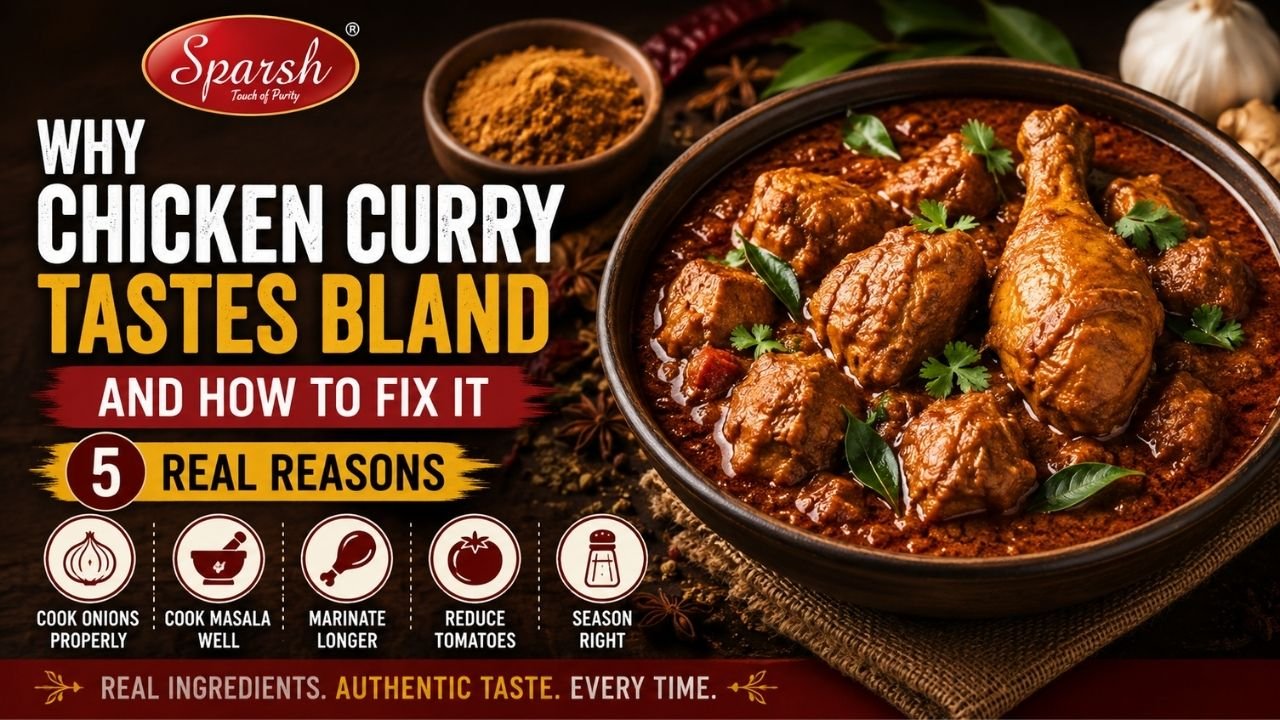
Why Chicken Curry Tastes Bland and How to Fix It (5 Real Reasons)
Why chicken curry tastes bland and how to fix it usually comes down to five specific gaps between what a recipe assumes and what actually happens in a home kitchen, not a missing secret ingredient. If your curry looks right, smells right, but falls flat on the tongue, the fix is almost always in technique, not in adding more chilli powder.
We hear this question constantly from home cooks who’ve followed a recipe exactly and still end up with something that tastes thinner than what they remember from a restaurant or their mother’s kitchen. This opens our Non-Veg Cluster alongside our Fish Curry Masala guide, focused this time on the mistakes specific to chicken.
Pro Tip: If your curry tastes bland right after cooking but better the next day, the problem isn’t your spices. It’s that you’re not letting the masala cook long enough before adding the chicken.
Why Chicken Curry Tastes Bland: The 5 Real Reasons
A flat-tasting curry is rarely one big mistake. It’s usually a handful of small shortcuts stacking up.
1. Onions that aren't cooked long enough
Undercooked onions are the single biggest reason home curries taste thin. Onions need to cook down until genuinely golden-brown, not just translucent, since that colour change is a sign the Maillard reaction has properly taken place, the same browning process responsible for the depth in a seared steak or a well-roasted vegetable. That’s what releases the natural sweetness and complexity that forms the base of a good curry, not just heat alone.
Warning Tip: If your onions still look pale and crunchy after 5 minutes, they’re not ready. Proper golden-brown onions usually take 12-15 minutes on medium flame, not a rushed 5.
2. Masala added too late or cooked too briefly
Adding your masala powder just before the chicken, then cooking for only a minute, doesn’t give the spices time to release their oils. The masala needs to cook in oil until it visibly darkens and the raw smell disappears completely.
Success Tip: Cook the masala until you see a thin layer of oil separate at the edges of the pan. That’s the visual sign the spices are actually cooked through, not just heated.
3. Not marinating the chicken long enough
Chicken that goes straight from the packet into the pan doesn’t have time to absorb any seasoning before cooking. Even a 20-30 minute marinade with turmeric, salt, and a little ginger garlic paste makes a noticeable difference to how deep the final flavour is.
4. Skipping the tomato reduction step
Adding chopped tomato and moving on quickly leaves the curry tasting raw and acidic instead of rounded. Tomatoes need to cook down fully, until they lose their raw smell and the mixture turns glossy, before the masala goes in.
5. Underseasoning, not under-spicing
The most common fix people reach for is more chilli powder or garam masala, when the real issue is often salt. Salt doesn’t just make food “salty,” it’s what carries every other flavour in the dish. A curry with the right spices but too little salt will always taste muted.
Pro Tip: Taste and adjust salt in stages, once after the tomato reduces and once again after the chicken is fully cooked. Flavours shift as the curry reduces, and a final adjustment often makes the biggest difference.
Ingredients That Build a Deep Curry Base
| Step | Ingredient | Role |
|---|---|---|
| Base | Onions, cooked until golden-brown | Sweetness and body |
| Aromatics | Ginger garlic paste | Depth and pungency |
| Masala | Sparsh Super Chicken Masala | Core flavour, cooked in oil until oil separates |
| Acid | Tomatoes, reduced fully | Rounds out the sauce, balances richness |
| Fat | Oil or ghee | Carries fat-soluble flavour from spices |
| Finish | Fresh coriander, a squeeze of lemon | Brightens the final dish |
Step by Step: How to Build Flavour Into Chicken Curry
Getting real depth in a curry comes down to giving each stage enough time, not adding more ingredients.
- Marinate the chicken with turmeric, salt, and a little ginger garlic paste for at least 20-30 minutes. (20-30 min)
- Heat oil and cook sliced onions on medium flame until genuinely golden-brown, stirring occasionally. (12-15 min)
- Add ginger garlic paste and cook until the raw smell fully disappears. (2 min)
- Add chopped tomatoes and cook down until soft, glossy, and the oil starts to separate. (6-8 min)
- Lower the flame and add Sparsh Super Chicken Masala. Cook, stirring, until the oil visibly separates at the edges. (2-3 min)
- Add the marinated chicken and cook on medium-high until it’s sealed on all sides. (5-6 min)
- Add water for the desired gravy consistency, cover, and simmer until the chicken is fully cooked through. (15-20 min)
- Taste and adjust salt, finish with fresh coriander and a squeeze of lemon if you like a brighter finish.
Frequently Asked Questions
1. Why does restaurant chicken curry taste better than mine at home?
Restaurants typically cook onions and masala in larger batches for longer, building a deeper base than most home cooks have time for on a weeknight. Slowing down the onion and masala stages, even by 5-10 extra minutes, closes most of that gap.
2. Can I fix a bland curry after it's already cooked?
Yes, to an extent. Simmer it uncovered for a few extra minutes to reduce and concentrate the flavours, adjust salt, and add a small amount of freshly cooked masala paste stirred in at the end if it’s still flat.
3. Does marinating chicken actually make a difference?
Yes, even a short 20-30 minute marinade with turmeric, salt, and ginger garlic paste lets the seasoning penetrate the meat rather than just coating the outside, which noticeably deepens the final flavour.
4. Why does my curry taste sour instead of balanced?
This usually means the tomatoes weren’t cooked down long enough before the masala was added. Undercooked tomato stays acidic; fully reduced tomato mellows and rounds out into the base of the curry.
5. Is Super Chicken Masala the same as Chicken Kabab Masala?
No. Super Chicken Masala is formulated for gravies and curries, while Chicken Kabab Masala is designed for dry marination and frying. Using the curry-specific blend gives a rounder, gravy-appropriate flavour rather than a fry-forward one.
6. How much oil should a good chicken curry actually use?
Why chicken curry tastes bland and how to fix it comes down to patience at each stage, not more spice on top of an undercooked base. Properly browned onions, a fully cooked masala, a reduced tomato base, and a short marinade solve most flavour problems on their own. With Sparsh Super Chicken Masala built specifically for curries rather than dry frying, the rest comes down to giving each step the time it actually needs.
Shop Sparsh Super Chicken Masala → Explore More Sparsh Recipes →
Conclusion
Why chicken curry tastes bland and how to fix it comes down to patience at each stage, not more spice on top of an undercooked base. Properly browned onions, a fully cooked masala, a reduced tomato base, and a short marinade solve most flavour problems on their own. With Sparsh Super Chicken Masala built specifically for curries rather than dry frying, the rest comes down to giving each step the time it actually needs.
Shop Sparsh Super Chicken Masala → Explore More Sparsh Recipes →