
Best Masala for Mixed Vegetable Curry | Complete Recipe
Mixed vegetable curry (learn more about curry history and regional variations on Wikipedia) is one of the most versatile and practical dishes in Indian cooking. It is quick to make, uses readily available vegetables, works for lunch boxes and family dinners, and can be served with rice, bread, or even on its own.If you are exploring other Indian curry variations, see our complete guide to the best spices for vegetable curry. But here is the challenge most home cooks face: mixed vegetable curry often turns out bland, watery, and forgettable. The vegetables cook but the flavour is flat. The spice is there but not layered or interesting.
The difference between mediocre mixed vegetable curry and exceptional mixed vegetable curry comes down to one thing: the masala. The right masala elevates simple vegetables into something deeply flavourful, aromatic, and crave-worthy. The wrong masala — or worse, no masala strategy at all — results in something you forget you ate.
In this complete guide, we walk you through the best masala for mixed vegetable curry, ingredient selection, the step-by-step recipe, cooking techniques that bring out flavour, and troubleshooting tips for common mistakes. By the end, you will have a mixed vegetable curry that tastes like restaurant quality every single time.
Why Mixed Vegetable Curry Needs the Right Masala
Mixed vegetable curry is a simple dish on paper: vegetables, gravy, spices. But simplicity is where technique matters most. When you have only a few components, each one needs to be excellent. The masala is the component that carries all the flavour.
The masala needs to do several things at once. It needs to provide warmth and depth. It needs to complement multiple different vegetables without clashing with any of them. It needs to work both early in cooking (building the gravy base) and late in cooking (finishing flavour). It needs to balance spice with aroma without being sharp or bitter. Most generic curry powders fail at one or more of these requirements.
The best masala for mixed vegetable curry is one that is balanced, aromatic, and works across multiple vegetables. It contains both base spices that build the gravy and finishing spices that add aromatic complexity. It is neither too heavy nor too light. This is why choosing the right masala matters so much for this dish.
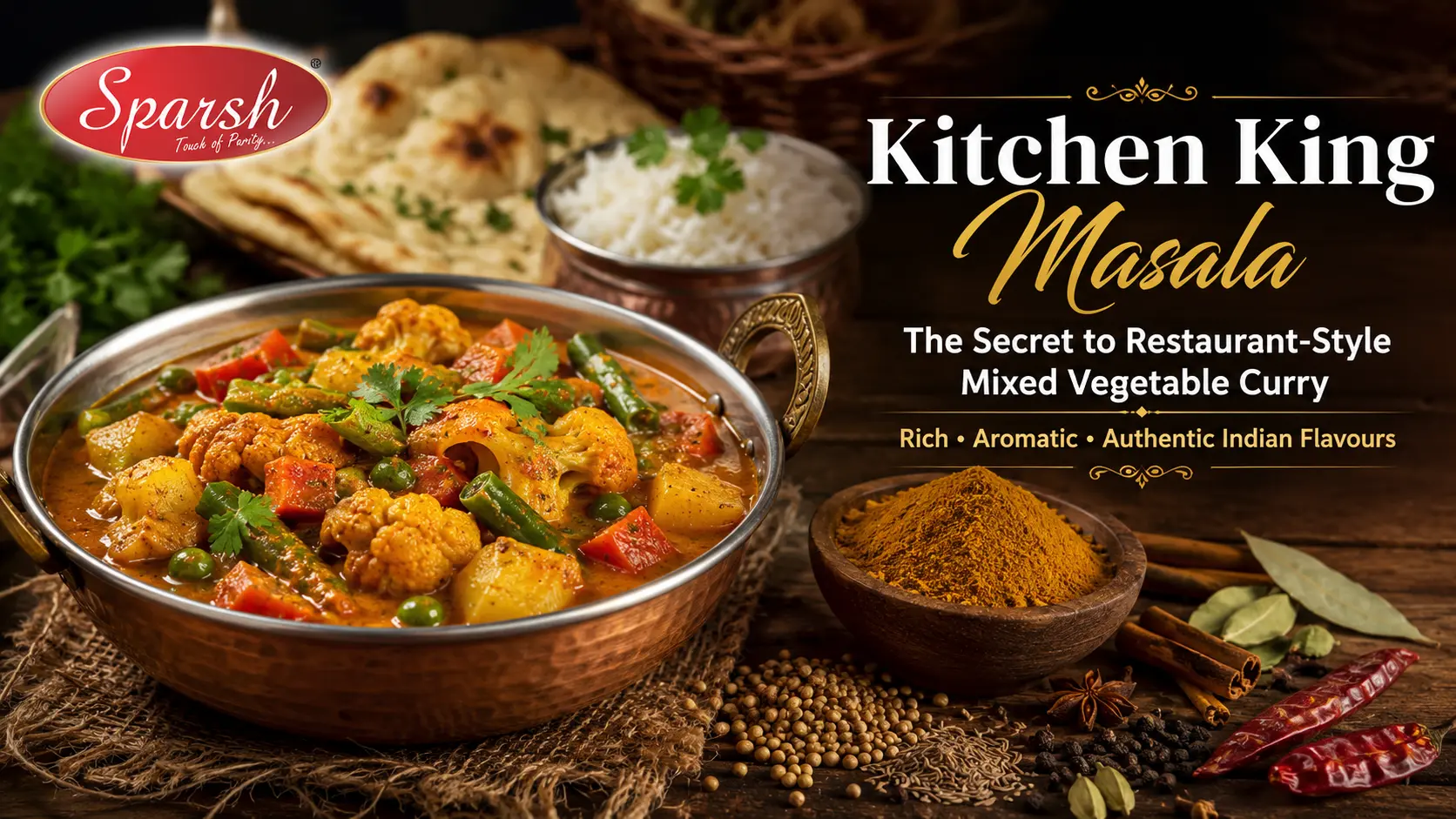
Best Masala for Mixed Vegetable Curry
There are several options for the best masala for mixed vegetable curry, depending on your cooking style and regional preference.
Option 1: Kitchen King Masala (Recommended for Easy Cooking)
Kitchen King Masala is an all-purpose North Indian spice blend that works beautifully in mixed vegetable curry. It contains a balanced mix of coriander, cumin, turmeric, and other warming spices. The advantage is simplicity — you add one masala and it handles the bulk of the flavouring. The disadvantage is that it can taste one-dimensional if you do not layer other spices around it. Use Kitchen King Masala as your base and add fresh ginger-garlic paste and a touch of garam masala at the end for dimension.
Option 2: Curry Powder with Layered Spices (Recommended for Depth)
A good quality curry powder provides the turmeric base and foundational spice. But to create restaurant-quality flavour, layer it with additional spices: add whole cumin seeds and coriander seeds at the start, fresh ginger-garlic paste during cooking, and finish with a pinch of garam masala. This approach gives you control over flavour development at each stage of cooking.
Option 3: Custom Spice Blend (Recommended for Advanced Cooks)
Make your own spice combination: start with 1 tablespoon curry powder as the base, add 1/2 teaspoon cumin, 1/2 teaspoon coriander, 1/4 teaspoon turmeric, 1/2 teaspoon chilli powder, and finish with a pinch of garam masala. This gives you maximum control and the freshest flavour.
For this recipe, we recommend Kitchen King Masala combined with fresh spices for the best balance of convenience and flavour depth.
Ingredients for Best Mixed Vegetable Curry (Serves 4–5)
For the Vegetables
2 medium potatoes — cut into 1-inch cubes
1 cup cauliflower — cut into small florets
1 cup carrots — cut into chunks or slices
1 cup green beans — cut into 1-inch pieces
1 cup peas — fresh or frozen
1 small onion — diced
1 green bell pepper — cut into chunks
For the Gravy and Masala
3 tablespoons oil or ghee
1 tablespoon Kitchen King Masala
1/2 teaspoon turmeric powder
1 tablespoon ginger-garlic paste
2 green chillies — minced
2 tablespoons tomato puree or 1/2 cup crushed tomatoes
1 cup yogurt or 1/2 cup coconut milk
1/2 teaspoon garam masala — for finishing
Salt to taste
Water as needed
For Garnish
Fresh coriander leaves – chopped. Fresh mint leaves – chopped (optional)
Step-by-Step Recipe for Mixed Vegetable Curry
Step 1: Prepare the Vegetables
Cut all vegetables into uniform sizes so they cook evenly. Potatoes should be slightly smaller than other vegetables because they take longest to cook. Keep all vegetables ready before you start cooking.
Step 2: Heat Oil and Add Base Aromatics
Heat 3 tablespoons of oil or ghee in a heavy-bottomed pan on medium heat.
Add the diced onion and stir continuously until it turns golden brown (about 4-5 minutes). Golden onion provides depth and sweetness to the gravy.
Step 3: Add Ginger-Garlic and Chillies
Add the ginger-garlic paste and minced green chillies. Stir for 20-30 seconds until fragrant. Do not let the paste brown or it will become bitter.
Step 4: Add Tomato Puree and Add the Masala
Add tomato puree or crushed tomatoes and stir for 1-2 minutes. The tomato cooks slightly and blends with the oil to create a flavour base. Add 1 tablespoon Kitchen King Masala and 1/2 teaspoon turmeric powder. Stir well so the masala coats everything evenly and cooks with the tomato mixture for 1 minute. This cooking step activates the spice flavours.
Step 5: Add Potatoes First
Add the potatoes (they take longest to cook) and stir so they are coated with the masala. Let them cook for 2-3 minutes.
Step 6: Add Remaining Vegetables
Add carrots and cauliflower florets. Stir everything together. Let this cook for 3-4 minutes.
Step 7: Add Yogurt or Coconut Milk and add Water and Simmer
Add 1 cup yogurt or 1/2 cup coconut milk. Stir well to combine. The yogurt or coconut milk creates the gravy base and adds richness and creaminess.
Add 1-1.5 cups of water depending on how thick you want the gravy. Bring to a simmer on medium-high heat, then reduce to medium-low and cover with a lid.
Simmer for 8-10 minutes until potatoes are tender and other vegetables are cooked but still have a slight crunch.
Step 8: Add Green Beans and Peas
Add green beans and peas (they cook faster than other vegetables). Simmer for another 3-4 minutes until all vegetables are tender.
Step 9: Finish with Garam Masala and Salt
Add 1/2 teaspoon garam masala and salt to taste. The garam masala adds aromatic warmth and complexity to the finished curry.
Transfer to a serving dish and garnish with fresh coriander leaves and mint (if using).
Serve hot with rice, roti, or naan.
Tips for Perfect Mixed Vegetable Curry
Use the right oil temperature. Oil that is too cool will make the onions stew instead of caramelize. Medium heat is ideal — you want gentle cooking, not aggressive heat.
Cut vegetables uniformly. This ensures even cooking. Small pieces cook faster than large pieces, so if sizes vary, some will be mushy while others are undercooked.
Do not overcook the vegetables. The vegetables should be tender with a slight firmness, not mushy. Mushy vegetables taste bland and watery. Stop cooking as soon as they reach the tender-crisp stage.
Layer your spices. Add masala powder early to build the gravy base, then add garam masala at the end for aromatic finishing. This two-stage spicing creates depth.
Use quality masala powder. The difference between a good masala and a cheap masala is immediately noticeable in the final curry. Quality masala uses whole roasted spices, not stale pre-ground powder. Sparsh Masala Kitchen King Masala is made from whole roasted spices and delivers noticeably better results.
Adjust consistency to your preference. If the curry is too thick, add more water. If it is too thin, simmer uncovered for a few minutes to reduce the liquid.
Frequently Asked Questions
1. Which vegetables are best for mixed vegetable curry?
The best vegetables for mixed vegetable curry are those that cook at similar rates and complement each other flavour-wise. Potatoes, cauliflower, carrots, green beans, peas, and bell peppers are ideal. Avoid very delicate vegetables like spinach or tomatoes as they break down quickly. You can also add broccoli, zucchini, or mushrooms. The key is variety in colour and texture, and similar cooking times.
2. Can I make mixed vegetable curry with only one masala?
Yes, you can use only Kitchen King Masala or curry powder and still get good results. However, the flavour will be one-dimensional. For restaurant-quality depth, layer your spices: use masala powder as the base, and add fresh ginger-garlic paste and garam masala for complexity. This layering is what separates ordinary from exceptional curry.
3. How long can I store mixed vegetable curry?
Mixed vegetable curry lasts 3-4 days in an airtight container in the refrigerator. The flavour actually deepens as it sits overnight. You can also freeze it for up to 2 months. Reheat gently on the stovetop or in the microwave, adding a splash of water if needed.
4. Can I make mixed vegetable curry in a pressure cooker?
Yes, absolutely. Reduce the cooking time to 3-4 minutes on high pressure. Pressure cooking is faster but uses slightly less water. The vegetables will be softer than stovetop cooking. For firmer vegetables, use the stovetop method and simmer with the lid off at the end.
5. What if my mixed vegetable curry tastes bland?
Blandness usually means insufficient masala or low-quality masala powder. Add more salt first (salt enhances flavour perception), then add a pinch more garam masala. If using cheap masala powder, the flavour will always be flat — switch to quality masala like Sparsh Masala. You can also add a tablespoon of lemon juice or vinegar to brighten the flavour, or a pinch of sugar to balance the spices.
CONCLUSION
The best masala for mixed vegetable curry is one that is balanced, aromatic, and layered. Kitchen King Masala provides the convenient base, but the real flavour comes from proper technique: layering spices at different stages of cooking, using quality ingredients, and cooking vegetables until just tender. This complete recipe gives you restaurant-quality mixed vegetable curry every time. The key is understanding that simplicity requires precision — with few components, each one needs to be excellent. Use quality masala powder, follow the technique carefully, and you will create a mixed vegetable curry that tastes deeply flavourful and complex, not bland and watery.
Shop Sparsh Masala Kitchen King Masala and build your spice pantry with quality ingredients